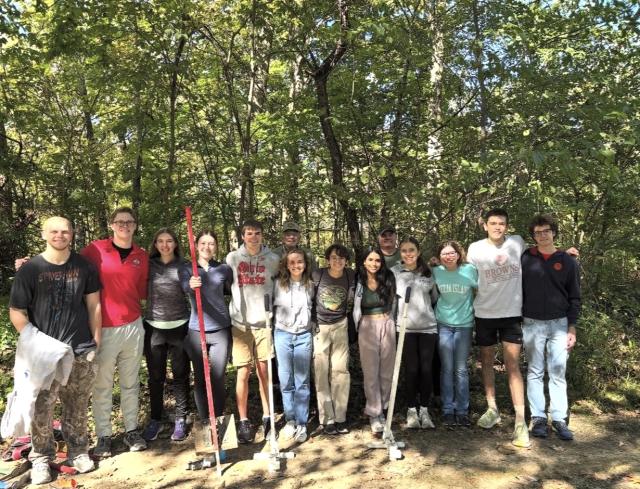
At Ohio State, sustainability is more than a classroom concept. Through partnerships with Facilities Operations and Development (FOD), students are creating living laboratory spaces on campus where innovative ideas can be tested, refined and scaled to make a lasting impact.
One of the latest examples is an air quality monitoring initiative led by the student environmental organization ECOspace. In summer 2025, the group received a $5,000 Youth Climate Action Fund grant to install PurpleAir monitors across campus that measure volatile organic compounds, PM2.5 and other airborne pollutants in real time.
"Projects of this nature demonstrate how FOD supports student learning while maintaining strong alignment with the university's core academic mission," said Chuck Petty, associate director of FOD. "Such efforts also underscore the value of facilitating student innovation, enabling ideas to be developed and implemented in ways that contribute meaningfully to both the campus environment and the broader community."
FOD staff worked with students to identify installation sites, coordinate logistics and integrate the monitors into existing campus infrastructure. The monitoring network will provide students, faculty, researchers and facilities professionals with real-time data to better understand air quality conditions across campus, identify pollution trends and support sustainability and public health efforts.
"FOD was a vital partner in making our ideas of implementing air quality monitors on campus a reality,” said Madison Langston, publicity director for ECOspace and a third-year environmental engineering student. “It was refreshing to work with a department that shared the same passion we did for bringing this project to life."
Another student-led project, the award-winning Shut the Sash initiative, demonstrates how partnerships with FOD can turn ideas into practical solutions.
Developed through Ohio State Energy Partners' (OSEP) 2026 Smart Campus Challenge, the project uses Ohio State's building automation infrastructure to track laboratory fume hood sash positions and their energy impacts in real time.
The team paired a digital dashboard with a BuckeyeLearn training module and laboratory signage to encourage researchers to adopt more energy-efficient practices while providing facilities staff with actionable data. FOD Sustainability staff advised the students throughout the project and connected them with the Building Automation Systems team and other campus experts to ensure the solution could be implemented using existing infrastructure.
"After all our investigation, we learned that creating the solution was the easier part,” said Satvik Gupta, a fifth-year chemical engineering student. “Deeply understanding the problem is where most of our effort was spent.”
The project earned first place in the Smart Campus Challenge, along with $60,000 to support implementation and an opportunity for the team to participate in sustainability programming at ENGIE headquarters in Paris. The initiative is now entering its pilot phase.
These projects reflect FOD's commitment to experiential learning by helping students apply classroom knowledge to real-world challenges. During the past academic year, the FOD Sustainability and Resource Stewardship team engaged 425 students through class projects, classroom presentations, Zero Waste Stadium tours and data requests that supported student learning.
Learn more about FOD Sustainability and Resource Stewardship at https://fod.osu.edu/sustainability